Meet Our Coaches
Each quarter, our newsletter shines a light on a small number of coaches from the Stichting Treehouse Coaching network. Through these conversations, we explore what inspires them, how they think about coaching, and why they believe making high-quality coaching accessible can create positive change far beyond the individual.
On this page, you’ll find both the edited & full (unedited) interview. While our newsletter does feature the edited version, we wanted to share the complete conversation as well so you can hear each coach’s voice in full and explore their reflections on coaching, leadership, social impact, and the experiences that shape their practice.
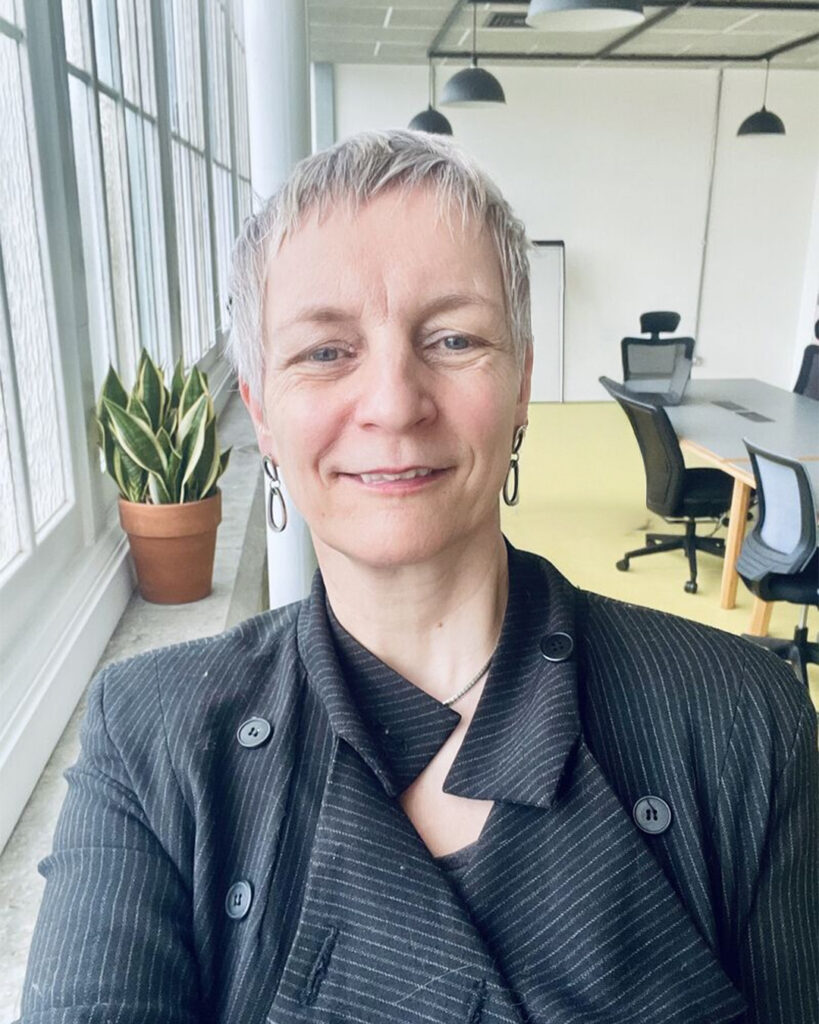
In this interview, we shine a light on Dr. Sybille Schiffmann—their journey into coaching, what continues to inspire their work, and their vision for making coaching accessible to all.
Interview with Dr. Sybille Schiffmann (Edited version)
“Access to coaching is also about access to voice, reflection and possibility.”
For Treehouse coach Sybille, coaching begins with a simple but profound belief: every person deserves to be listened to carefully, taken seriously, and given the space to explore what might be possible next.
Throughout her career, she has worked alongside leaders, teams and purpose-led organisations navigating complexity, uncertainty and change. What continues to inspire her is witnessing the moment when someone begins to see themselves—and their situation—differently.
“People often arrive carrying more wisdom, resilience and resourcefulness than they realise,” she says. “Coaching can help bring those strengths into view.”
Sybille was drawn to Stichting Treehouse Coaching because of its commitment to making high-quality coaching available to people who might otherwise be excluded from it.
“Coaching is still too often treated as a privilege for those already close to power,” she says. “Yet the need for reflection, encouragement and support is not confined to those groups.”
Treehouse’s mission resonates with her belief that coaching should be accessible to anyone navigating change, transition, displacement or uncertainty—not only those with financial means or organisational backing.
At the heart of her work is the conviction that coaching is not about fixing people.
“It is about creating the conditions in which people can recognise their own resourcefulness, make sense of their experiences, and take their next steps with dignity and agency.”
Full (Unedited) Interview
1. What brought you to coaching, and what keeps you inspired today?
I came to coaching through a deep interest in how people find their voice, confidence and direction, particularly at moments of complexity, transition or uncertainty. Much of my work has been with leaders, teams and purpose-led organisations who are trying to create something meaningful, often while navigating pressure, ambiguity and change.
What keeps me inspired is witnessing the moment when someone begins to see themselves and their situation differently. I have often been told that my coaching creates a space that feels both safe and stretching: a place where people can think out loud without judgement, while also being challenged to move beyond familiar patterns. That combination matters to me. Coaching should not simply soothe people, nor should it push them unkindly. At its best, it helps people feel grounded enough to be courageous.
I am also a practising fine art photographer, and that shapes my coaching. Photography has taught me that what we notice depends on where we stand, what we frame, what light is available, and what remains outside the image. Coaching, too, is about helping people shift perspective, notice what has been hidden, and compose a more truthful and life-giving way forward.
2. What drew you to Stichting Treehouse and its mission?
I was drawn to Stichting Treehouse because its mission speaks directly to something I care about: making high-quality coaching available to people who might otherwise be excluded from it. Coaching is still too often treated as a privilege for executives, senior leaders or those already close to power. Yet the need for reflection, encouragement, clarity and support is not confined to those groups.
Treehouse’s mission feels aligned with a more democratic view of human development. Everyone deserves space to be listened to carefully, to explore their story, to reconnect with their strengths, and to imagine what might be possible next.
I am particularly moved by the commitment to people who may be navigating displacement, transition, social exclusion or limited access to professional development. For me, coaching is not about fixing people. It is about creating the conditions in which people can recognise their own resourcefulness, make sense of their experiences, and take their next steps with dignity and agency.
3. Why do you believe coaching should be accessible to more people?
Because access to good reflective space is unequally distributed. Many people carry extraordinary life experience, resilience and wisdom, yet may rarely be invited into conversations where their voice, choices and aspirations are taken seriously.
Coaching should not be reserved for people who already have status, income or institutional support. It can be especially powerful for people navigating unfamiliar systems, rebuilding identity, changing direction, or trying to find a place where their gifts can be recognised.
I also believe coaching can honour different ways of knowing. We do not only learn through analysis, formal qualifications or confident professional language. We learn through lived experience, emotion, body awareness, image, metaphor, memory, relationship and story. These forms of knowledge are often undervalued, especially in systems shaped by elite educational norms. Coaching can help restore dignity to those ways of knowing.
That matters because when people feel seen, they often begin to see themselves differently. They may become more confident, more able to name what matters, and more willing to act.
4. Tell us about a moment when you witnessed the impact of coaching extend beyond the individual.
I have seen many times that when one person changes their relationship with themselves, the effects ripple outwards. A leader who becomes more reflective may begin listening differently to their team. A person who gains confidence may communicate more clearly with colleagues or family. Someone who recognises their own patterns may begin to respond rather than react.
In my team and organisational coaching work, this ripple effect becomes very visible. When people learn to speak more honestly and appreciatively together, the whole system can shift. Conversations become less defensive. Decisions become clearer. People begin to share responsibility rather than waiting for direction from one person at the top.
Clients have described my work as helping them name patterns, step back from the day-to-day, think more strategically and create practical ways forward. That is where coaching can move beyond personal insight. It can change the quality of relationships, leadership cultures and collective action.
The impact of coaching is rarely contained within the coaching room. It travels through how people lead, parent, collaborate, challenge, listen and participate in their communities.
5. What does social impact mean to you in your coaching practice?
Social impact, for me, means supporting people in ways that increase dignity, agency, connection and contribution. It is not only about visible outcomes, although those matter. It is also about whether people feel more able to participate in shaping their own lives and the systems around them.
In my coaching practice, I am drawn to people and organisations who want to create wider positive impact for people and planet. That may include leaders in charities, education, health, social enterprise, community work, arts and culture, or purpose-led business. It may also include individuals rebuilding confidence and direction after disruption.
My clients often value that I combine warmth with rigour, and creativity with practicality. I see social impact in that same way. It needs both compassion and courage. It requires inner work, where people reconnect with values and confidence, and outer work, where those values are expressed in relationships, decisions, structures and action.
Coaching sits at the meeting point between those two movements: personal transformation and wider contribution.
6. Many people speak about changing systems. How can coaching contribute to meaningful change in communities, organisations, or society?
Systems change begins with how people see, relate, decide and act together. Coaching can contribute because it helps people become more conscious of the patterns they are part of. It can reveal assumptions, power dynamics, inherited stories and habits of silence that keep people and systems stuck.
At its best, coaching does not only ask, “What do you want to achieve?” It also asks, “What kind of world are you helping to create through the way you lead, speak, listen and choose?”
My doctoral research explored shared leadership and the co-creation of strategy, and that continues to shape my work. I do not believe meaningful change depends only on heroic individual leaders. It depends on people learning how to think together, share responsibility, include different voices and act with greater collective intelligence.
This is also where coaching needs creativity. Sometimes a metaphor, a visual image, a story or a different kind of question can help people see a system more clearly than a conventional model. Many clients have told me that the tools, frameworks and metaphors we use together stay with them long after the session. That matters because systems change requires learning that sticks.
7. What have you learned from working with people whose life experiences differ from your own?
I have learned humility. I have learned that expertise is useful only when it serves listening. I have learned that people’s stories cannot be reduced to the frameworks we bring, however thoughtful those frameworks may be.
Working with people whose life experiences differ from my own has deepened my respect for lived knowledge. People know things through survival, migration, parenting, caring, loss, exclusion, creativity, work, community and persistence. These forms of knowledge may not always arrive in polished professional language, but they are profoundly real.
As an artist, I am interested in what people communicate beyond words. Sometimes an image, a silence, a gesture, a metaphor or a remembered place can reveal something that ordinary professional language cannot reach. Coaching must make room for that. It must not only privilege the confident speaker, the fluent strategist or the person already comfortable in institutional settings.
This has taught me to listen with more than my intellect. I try to listen for feeling, context, imagination, energy and what may be trying to emerge.
8. Education and learning are often at the heart of transformation. What role do they play in your work?
Learning is central to my work, but I understand learning broadly. It is not only about acquiring knowledge or skills. It is about making meaning, recognising patterns, questioning assumptions and integrating experience.
Much of my practice is influenced by action research and the idea that there are many ways of knowing. We learn through practice, reflection, relationship, the body, emotion, story and images. Transformation happens when people can bring these different forms of knowing into conversation with one another.
Clients often describe my coaching as perspective-expanding. I value that because I do not see my role as giving people answers. I am more interested in helping them think more deeply, see more widely, and trust more of their own intelligence.
Education, in this sense, is not something done to people. It is a process of awakening, connecting and becoming more able to participate fully in life, work and society.
9. What gives you hope when you look at the future?
What gives me hope is the creativity and resilience I see in people, often in very difficult circumstances. I do not mean a simplistic kind of optimism. There is much in the world that is painful, unjust and uncertain. But I continue to see people caring, imagining, repairing and creating new possibilities.
I am hopeful when I see people refusing to separate personal development from social responsibility. More people are asking deeper questions about purpose, belonging, climate, equity, community and meaningful work. These questions are demanding, but they are necessary.
My work as an artist also gives me hope. Art reminds me that there is always more than one way to see. A shift in light can change the whole image. A different frame can reveal what was previously overlooked. I think human beings and communities are like that too. New possibilities often begin with a different quality of attention.
10. If every person had access to high-quality coaching, what might be different in the world?
If every person had access to high-quality coaching, I think more people would feel authorised to take their own lives seriously. They would have more space to reflect before reacting, to make choices aligned with their values, and to recognise the strengths they already carry.
We might see more people participating with confidence in their communities and workplaces. We might see leadership become less concentrated in a few voices and more distributed across many. We might see people becoming more able to listen across difference, because coaching can strengthen both self-awareness and empathy.
Of course, coaching alone cannot solve structural inequality. But it can help people reclaim voice, agency and imagination within systems that too often diminish them. If coaching were more widely available, the world might become a little less dominated by fear, silence and isolation, and a little more shaped by courage, relationship and possibility.
The Ripple Effect: What is one change — large or small — that you’d love to see emerge from Stichting Treehouse’s work over the next few years?
I would love to see Stichting Treehouse help shift the story of who coaching is for. I would like coaching to be understood not as an elite intervention, but as a meaningful form of support for people navigating change, exclusion, transition and new beginnings.
A beautiful ripple effect would be for those who receive coaching to carry some of that reflective, appreciative and empowering quality into their own families, communities and workplaces. Perhaps someone who has been deeply listened to becomes a better listener. Someone who has been encouraged begins to encourage others. Someone who has found language for their own story helps another person feel less alone.
That kind of ripple may look small at first, but it is how cultures begin to change.
Quick Questions
A value you try to live by:
Dignity. I try to remember that every person carries a story, a context and a form of wisdom that deserves respect.
A book that shaped your thinking:
I really want to acknowledge the work by Helen Lewis Difficult Women. This is a book that celebrates 12 feminists who were highly influential in creating positive change that has affected myself and other women living here in the UK today over the last 150 years or so. Their sphere of influence ranges from sport to abortion rights for women, from education to marriage. What strikes me about these women is that none of them were saints. Like me they were all flawed human beings, who often went unacknowledged for their contribution and who mostly had to overcome great obstacles to succeed even partially in their field and in their lifetime. Their dedication and belief in the ability of women to thrive, and succeed and be recognised in their own right is really inspiring for me.
Professionally, I am also deeply influenced by Appreciative Inquiry, the work of Martin Seligman, in particular his book Authentic Happiness and Barbara Fredriksen’s book, Positivity, and finally by the participatory traditions of action research.
A person who inspires you:
There isn’t one person.. I am inspired by people who create beauty, show courage and community in difficult circumstances: artists, social entrepreneurs, community leaders, refugees rebuilding their lives, and quiet change-makers who may never be publicly celebrated.
A place where you feel connected to yourself:
Often behind the camera, walking with attention, noticing light, texture, shadow and the overlooked details of a place. Photography helps me slow down and return to a deeper form of seeing.
One word that describes your coaching style:
Appreciative.
One thing you’d like readers to remember:
People are rarely empty vessels waiting to be filled. More often, they are carrying resources, experiences and possibilities that need the right conditions to come into view.
Closing Question: Stichting Treehouse exists to help make coaching accessible to people who might not otherwise have the opportunity. Why does that matter to you?
It matters because access to coaching is also about access to voice, reflection and possibility. Many people are navigating complex lives without enough spaces where they can be fully heard, taken seriously and supported to make sense of their next steps.
For me, making coaching more accessible is an issue of dignity and social justice. It recognises that people who have been under-represented, displaced or excluded are not simply people with needs. They are people with knowledge, creativity, courage and contribution.
I believe coaching can help people reconnect with their own agency at moments when life may have made them feel powerless or unseen. It can offer a space where their story is not reduced, where their strengths are recognised, and where new choices can begin to emerge.
That matters because when people are supported to flourish, the benefits do not stop with them. They ripple into families, organisations, communities and society.