What happens when the invisible rules of the workplace begin to shape how we lead, work and live? Sarah Weissberg knows these dynamics from her years in the world of opera and classical music, where hierarchy, perfectionism and deeply rooted gender patterns are part of the landscape.
Today, as a coach focused on female leadership, she helps women recognise the patterns beneath the surface and step more consciously into their leadership. In this Treehouse Coach Spotlight, Sarah shares why she believes inner work can create outer change, why coaching matters particularly in the arts, and what curious children can teach us about hope for the future.
In this interview, we shine a light on Sarah Weissberg—their journey into coaching, what continues to inspire their work, and their vision for making coaching accessible to all.
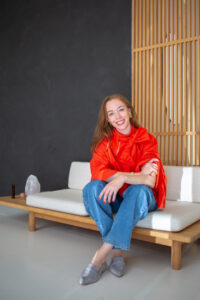
Sarah Weissberg on female leadership, the arts and the power of looking beneath the surface (Edited Version)
“Inner work leads to outer results. Even without a spoken word.”
For Sarah Weissberg, the path to coaching began backstage. After starting her career in cultural management in the world of opera and classical music, she became increasingly aware of the hierarchies and gender inequalities embedded in the sector. Orchestras and opera houses remain highly structured environments, with women still underrepresented in many leadership positions. Having experienced what it means to be the only woman in the boardroom-as well as the challenge of balancing motherhood and career-Sarah found herself wanting to support women in pursuing their ambitions and claiming their place at the table.
Today, Sarah coaches female professionals on their career and leadership journeys, with a particular focus on gender equality and female leadership. But her approach goes beyond conventional career development. As a trained psychodynamic coach and supervisor, she is interested in the beliefs and patterns that operate beneath the surface: the experiences, socialisation and assumptions that influence how we communicate, make decisions and lead-often without us being fully aware of them.
Her years in the arts showed her how these invisible patterns can become organisational culture. Early in her career she encountered the phrase Alles für die Kunst-“everything for the arts”. It took her some time to realise how literally it was often lived: long hours, evenings and weekends, dedication of body and mind, and sometimes the crossing of personal boundaries without question. For Sarah, coaching offers a way to make these unspoken rules visible. “What is unspoken becomes speakable,” she
says-and once we can see a pattern, we have a greater chance of changing it.
Sarah has experienced this process herself. Through coaching, working on her own values and needs helped her develop a clearer sense of presence and stance in her leadership. Something shifted internally, and the outside world seemed to respond almost immediately. It is an experience she now recognises in her clients. Her guiding thought is simple: “When the inner world changes, the outer world rearranges.”
This belief also informs the more holistic dimension of Sarah’s work. A certified yoga and meditation teacher, she sometimes integrates body, mind and subconscious belief work into her coaching. She sees reflection as a powerful driver of development-particularly when we have a safe space and another person to help us look beneath the surface. Having lived and worked across Austria, Germany and the Netherlands has reinforced this for her: encountering different cultures can challenge the assumptions we have inherited and give us a new perspective on ourselves.
It was this combination of accessibility, the arts and personal development that drew Sarah to Stichting Treehouse Coaching. She recognises that coaching remains a privileged service and that, particularly within the arts, professional coaching and supervision are far from a given. Through Treehouse, she sees an opportunity to make reflective space available to people who might otherwise not have access to it-and, through those individuals and teams, potentially create a wider ripple of change.
So what does Sarah hope for from Treehouse in the years ahead? She would like to see people change the way they understand their professional lives and, consequently, the way they lead. She returns to Brené Brown’s words: “Who we are is how we lead.” Her own one-word description of coaching is empowering, her guiding value is trust, and the message she hopes readers remember is perhaps the simplest of all: inner work leads to outer results-even without a spoken word.
Unedited Version:
Introduction
As a coach I accompany female professionals alongside their career and leadership path. With a background in cultural management, I started my own career in the world of opera and classical music until I decided to support women in their professional growth. I am particularly passionate about gender equality and “Female Leadership”.
I have also increasingly engaged with holistic concepts of personal development in recent years. As a certified yoga and meditation teacher, I bring a holistic perspective to my coaching work, integrating subconscious belief work into the development journey. This approach strengthens the connection between body, mind, and soul, in order to foster the foundation to grow into conscious, resilient leadership.
With my Austrian heritage I have grown up in an environment where arts and culture were always present. After 10 years of working in Germany, my partner and our little son chose to move to Amsterdam, the city that always had our heart.
In Conversation With Sarah
- What brought you to coaching, and what keeps you inspired today?
Well, working in the world of classical music, you are surrounded by traditional structures and hierarchies. An orchestra is a highly hierarchical collective, a fact that runs through the work place behind the scenes as well – and has an impact on the organisation’s work culture. Besides hierarchies, opera and orchestras are also very male dominated when it comes to leading positions – a factor that still carries historic patriarchal influence which hasn’t changed fundamentally until now. We’re speaking about elite and perfection, and the more prestigious it gets, the less women appear at the top. This also reflects in the lack of female conductors for example. I have experienced myself how it feels to be the only woman in the board room, and faced inequalities when it comes to balancing motherhood and career. That being said, I found myself on a mission to support women who want to follow their career goals and claim their seats at the table. In my opinion, the best way to make that happen is by being a sparring partner for those who need support.
- What drew you to Stichting Treehouse and its mission?
I saw a post from Kai on LikedIn sharing the „launch event“ of Stichting Treehouse Coaching. Hearing about a foundation that is dedicated to support the arts through coaching immediately caught my attention, knowing that coaching is a service that is not very popular or present within the arts. And especially for artists it is not always accessible. Plus I felt that what I read about the Stichting’s mission resonated 100% with mine.
- Why do you believe coaching should be accessible to more people?
I am trained in a psychodynamic coaching and supervision approach. With that perspective, I assume that the experiences that have shaped a person in the past, are re-enacted in the here and now. I believe that our socialization and habitus created patterns that we are often not aware of and that lead our behavior, the way we make our decisions, how we lead or communicate in our professional life as well. This is true on an individual level, but also for organizations. Therefore I believe that including a subconscious perspective on our behavior is key to transformation and change. Imagine, every leader would reflect on his or her behavior? How would our working environments look like?
- Tell us about a moment when you witnessed the impact of coaching extend beyond the individual.
I like to follow the sentence „When the inner world changes the outer world rearranges“. I have witnessed a change with people I worked with after changing the own perception of myself – and by becoming aware of my own inner dynamics (and conflicts). In a coaching that I took myself, I worked on my own values and needs, that helped me develop a certain stance and attitude that I stepped into without even using words. I became present and clear in my leadership role – like something inside me aligned, and the outside almost immediately reacted to that.
I am happy to see that the „inner“ work, the change in self-perception, also shows visible effects in the work I do with my clients.
- What does social impact mean to you in your coaching practice?
Well, I am aware of the fact that coaching is a privileged service and is not always accessible for every professional. What I also see in the world of music and arts, is that coaching or supervision is not a given. With the lack of financial resources professional support is not always seen as a priority.
Therefore I hope that my work finds social impact through the individuals and teams I work with – but through an initiative like Stichting Treehouse Coaching, I feel the chances are even higher to make an impact for the right people and fields.
- Many people speak about changing systems. How can coaching contribute to meaningful change in communities, organisations, or society?
Having made my own professional experiences in large (federal) cultural organisations, I have witnessed how subconscious patterns work their way from an organization through their individuals and back. The first thing I learned when I started working in the arts was the sentence „Alles für die Kunst“, meaning „giving it all for the arts“. It took me a while to realize that it was truly meant like that. Playing an instrument, acting, dancing – all of that includes dedication of your time, body, mind – basically your whole life – to music, art or literature. This unspoken words are subconscious belief sentences that become „laws“ at a workplace and shapes the dynamic within it. It leads to the crossing of boundaries, high amounts of working hours, in the evenings and weekends – in many roles even without questioning it. If we see coaching as a way to reflect on underlying and subconscious patterns, among individuals, teams and organisations, the unspoken becomes speakable and therefore hopefully able to be transformed in a way it serves the people.
- What have you learned from working with people whose life experiences differ from your own?
Having lived and worked in different countries and cultures, I believe that every society that is different than the one that you were brought up in, gifts you with insights about your own experiences and development. Reflecting and challenging the patterns that have shaped you is always a driver for development.
- Education and learning are often at the heart of transformation. What role do they play in your work?
I have always loved to learn new languages or skills. I was stunned how fast my 3-year-old was able to almost soak up the Dutch language – I felt like I have to keep up with him! I also feel very much drawn to ancient wisdom, exploring and learn how the world and natural cycles were being studied over thousands of years – and how to use this wisdom in our present time. During Covid I took a deep dive into astrology, subconscious healing techniques and later also became a yoga and meditation teacher myself. I love to include these skills in my coachings if I feel they are of benefit.
- What gives you hope when you look at the future?
When I look at the children in my son’s school or the playgrounds, how curious they look at the world, how much time they take to look at a little bug – I have hope that there will be humans growing up who make our world a better place.
- If every person had access to high-quality coaching, what might be different in the world?
I think I have covered that above.
The Ripple Effect
What is one change—large or small—that you’d love to see emerge from Stichting Treehouse’s work over the next few years?
To enable people with the ability to change their perspectives on how they see the professional work. I like to hold it with Breneé Brown: „Who we are is how we lead.“
Quick Questions
- A value you try to live by: Trust.
- A book that shaped your thinking: Jack Kornfield – The wise heart.
- A person who inspires you: Annalena Baerbock (former German foreign minister and President of the United Nations General Assembly) for making her point on “the future of foreign politics is feminist”.
- A place where you feel connected to yourself: Swimming in a cold mountain lake.
- One word that describes your coaching style: empowering
- One thing you’d like readers to remember: Inner work leads to outer results. Even without a spoken word.
Closing Question
Stichting Treehouse exists to help make coaching accessible to people who might not otherwise have the opportunity. Why does that matter to you?
I think that reflection is the key to change and development. Sometimes we need another person and a space where we feel safe enough to open up and look beneath the surface. Offering that possibility is a deep-hearted desire of mine and therefore I am happy to be part of this wonderful initiative.